
(Note: Draft version to be revised)
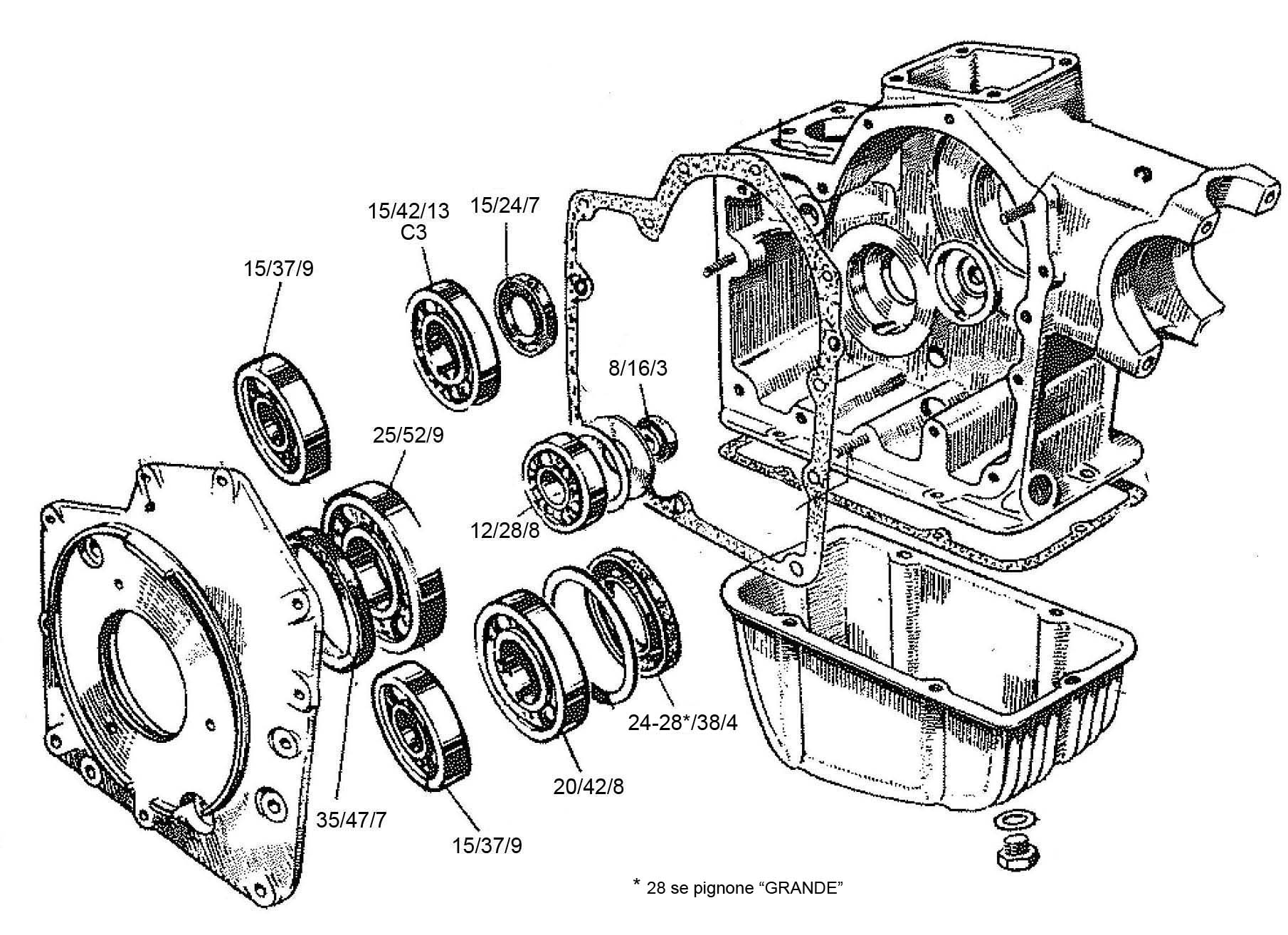
Image courtesy of motorcycle mechanic Roberto Montanari.
When overhauling a Motom engine, bearings and oil seals are among the smallest components, but also among the most important. They are often viewed as mere consumable parts, but in reality they directly affect the engine’s smoothness, reliability, and performance.
The Motom is a simple, sturdy engine, but it doesn’t have much power to spare. That’s exactly why even the slightest unnecessary friction is noticeable. A worn, stiff, or noisy bearing can sap some of the engine’s limited power, cause vibrations, raise operating temperatures, and make the engine run less smoothly.
The same applies to oil seals. An old, hardened, or improperly fitted seal can cause oil leaks, air ingestion, or lubrication problems. During a complete overhaul, it is therefore good practice to carefully inspect all bearings and replace the oil seals, even if they appear to be intact.
How to read bearing and seal sizes
The dimensions of bearings and oil seals are typically indicated by three numbers:
inner diameter / outer diameter / thickness
For example, a bearing designated as 15/37/9 has:
15 mm inner diameter, 37 mm outer diameter, and 9 mm thickness.
This is a simple step, but it’s essential for avoiding mistakes when purchasing parts. With vintage engines, it’s also always a good idea to compare the dimensions listed in the exploded view with the actual component removed from the engine.
Motom Engine Bearing Sizes
The exploded view of the engine shows the main dimensions of the bearings used:
| Measure | Quantity |
|---|---|
| 15/37/9 | 2 pieces |
| 25/52/9 | 1 piece |
| 15/42/13 C3 | 1 piece |
| 12/28/8 | 1 piece |
| 20/42/8 | 1 piece |
Before installation, it is important to verify that the bearings are the same size, the same type, and, where specified, have the same internal clearance.
Motom Engine Oil Seal Sizes
Seals also come in specific sizes and should not be chosen “by eye.” The main sizes listed in the exploded view are:
| Measure | Notes |
|---|---|
| 15/24/7 | shaft oil seal (some models use felt, but this one is still compatible) |
| 28/38/4 otherwise 24/38/4 | oil seal |
| 35/47/7 | crankcase/cover gasket, |
| 8/16/3 | Secondary shaft (Ariete special) |
The oil seal designated as 24-28/38/4* requires special attention. The internal diameter may vary depending on the type of sprocket installed. The exploded view specifies: 28 for the “large” sprocket.
This detail should not be overlooked, because an oil seal with an incorrect inner diameter may not fit properly on the shaft or spacer, causing leaks or insufficient sealing.
The two special Ariete oil seals
Not all Motom engine oil seals are standard, readily available sizes. Two of them are special and must be sourced as specific replacement parts.
The good news is that Ariete still manufactures an engine oil seal kit for the Motom 48 cc, identified by part number 07859 for the Motom 48 cc Model 51 Junior (1960–1962). The product is listed directly as an engine oil seal kit for the Motom 48 cc.
This is important because fitting similar but incorrect oil seals may seem like a quick fix, but it often causes problems. In a vintage engine, the seal must be positioned correctly, with the proper lip and the correct interference fit on the shaft.
An “almost identical” oil seal might not be good enough.
What does "C3" mean on a bearing?
The exploded view shows a bearing labeled 15/42/13 C3.
The designation C3 indicates a bearing with increased internal clearance compared to a standard bearing. This does not mean that the bearing is less precise or of lower quality. It means that it is designed to function properly under conditions where internal clearance tends to decrease.
This can happen for two main reasons: interference during installation in the housing and thermal expansion while the engine is running.
When cold, a standard bearing may seem to fit properly, but when hot, it may become too tight. This can result in increased friction, rising temperatures, premature wear, and a loss of smoothness.
For this reason, if the exploded view or parts list specifies a C3 bearing, it is best to follow that specification.
Why are bearings and oil seals so important on a Motom?
In a modern, powerful engine, a small loss of performance can go almost unnoticed. On a Motom, however, that’s not the case.
The Motom engine operates at low horsepower and derives much of its driving pleasure from its smoothness. If the bearings are in good condition, the engine runs more freely, runs less hot, vibrates less, and maintains its efficiency better.
On the contrary, hardened, noisy, or worn bearings can make it harder to rev up the engine. Oil seals also play a crucial role: they must ensure a proper seal without causing friction or leaks.
A good engine overhaul isn't just about pistons, piston rings, and gaskets. Bearings and oil seals make a difference, too.
Please note: engines manufactured prior to the 12E model
The measurements provided in this article apply to the most common engine family, but should not be assumed to apply to all Motom engines without verification.
For engines prior to the 12E, including the 12E, some bearings and seals may be slightly different.
This is a topic that deserves a separate discussion, because the early Motom models have design differences that should not be overlooked. We will devote a separate article to these engines.
A helpful tip before ordering replacement parts
Before purchasing bearings and oil seals for a Motom engine, it’s best to check three things:
the dimension shown in the exploded view, the dimension of the component that was actually removed, and the exact model of the engine.
With vintage vehicles, there may be differences between model series, production years, and parts that have been replaced over time. Double-checking before placing an order will prevent you from having to reopen the engine later.
Bearings and oil seals are inexpensive compared to the work involved in opening up a crankcase. That’s why it’s important to choose them carefully and install them properly.
We recommend reading: Which Oil to Use in Your Motorcycle — The Definitive Guide
If you found this article useful and would like to help keep Motom Club alive, you can support the project with a small contribution.
SUPPORT MOTOM CLUBAll content on this site is protected by copyright. Reproduction, even partial, is prohibited without written permission.