

Thursday, April 3, 1958. Monza was gray, cold, and lashed by rain. Running a small motorcycle for 24 consecutive hours in those conditions seemed like a crazy decision. Yet the Motom executives knew something the others didn’t see: their machine was ready.
The Challenge
At 10 a.m., in the presence of FMI commissioners Renato Negri and Leopoldo Casati, technical commissioners Luigi Secchi and Gianluigi Ottolini, and timekeepers Principato, Prolo, Giannini, and De Crescenzi, the attempt began. Five riders—Armando Pessina, Eugenio Saini, Giulio Pernigotti, Giuseppe Rossetti, Carlo Domenicali, and Gianfranco Rossetti—took turns regularly in the pouring rain, while the Motom 48 racked up lap after lap.
Despite the water leaks that caused a brief interruption, it was already clear after six hours that success was inevitable.
The records
After 11 hours, 29 minutes, and 4 seconds, the 1,000-km record was broken with an average speed of 87.073 km/h (previous record: 69 km/h). Shortly thereafter, the 12-hour record was set at 1,047.592 km at an average speed of 87.299 km/h. The run continued hour after hour in almost constant rain, and on Friday, April 4—after 500 laps—the 24-hour mark was reached with 2,135.985 km at an average speed of 88.832 km/h.
In total, the Motom 48 set 5 world records:
- Speed from a standing start: 82.436 km/h (previous: 76)
- 1,000 km: 87.073 km/h in 11 hours, 29 minutes, and 4 seconds (previous: 69)
- 12 hours: 1,047.592 km at 87.299 km/h (previous: 69.700)
- 24 hours: 2,135.985 km at 88.832 km/h (previous: 66.400)
- 24-hour 100cc class: previous record 80.700 km/h
- Fastest lap: 103 km/h
The detail that makes an impression
The previous records were held by Ducati. Motom improved on them by about 30%—and did so with a bike completely devoid of fairings, under treacherous weather conditions. If the conditions had been favorable, the numbers would have been even higher.
The standing start kilometer record was set by Armando Pessina, who clocked 42.97 seconds on the first lap and 44.36 seconds on the second.
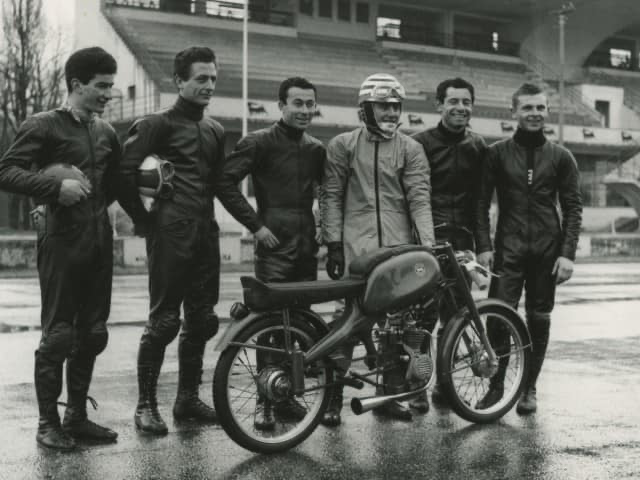
A 48cc bike doing 103 km/h. In 1958.
It’s worth pausing for a moment to consider this figure. We’re talking about a 48-cc engine—the displacement of a kid’s moped. And yet that little engine lapped the Monza circuit at an average speed of 103 km/h.
To give you an idea: today’s 50cc sports bikes can exceed 100 km/h, but almost always after modifications that bring the actual displacement up to 80cc or even more. The Motom 48 achieved this with its 48cc engine certified by FMI officials, in the rain, in 1958.
And not in a quick sprint session lasting just a few minutes—but as the fastest lap during a 24-hour marathon, in the rain, in a car without a body kit.
It means the engine was pushed to its absolute limit for hours on end, and the riders had complete confidence in that machinery. It means the Motom engineers had built something extraordinary—and they knew it.
Fifty years later, that record still tells us something important: engine displacement isn't everything. Ingenuity is.
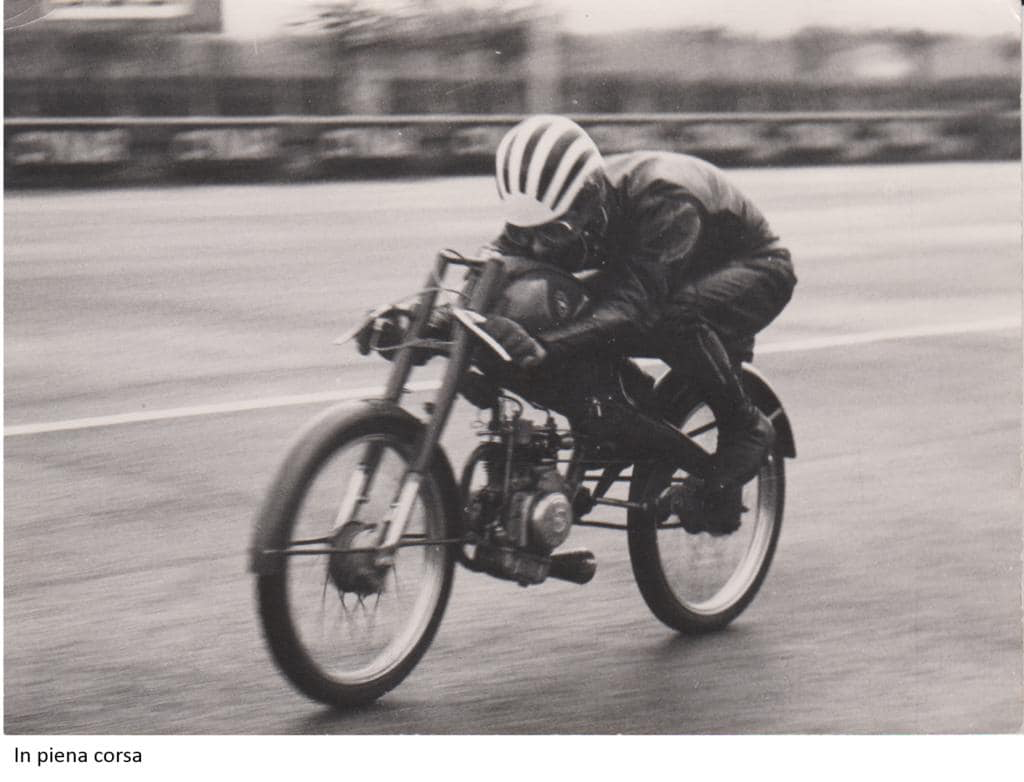
Photos courtesy of Massimo Prata of the Motom Club Zurich
If you found this article useful and would like to help keep Motom Club alive, you can support the project with a small contribution.
SUPPORT MOTOM CLUBAll content on this site is protected by copyright. Reproduction, even partial, is prohibited without written permission.