
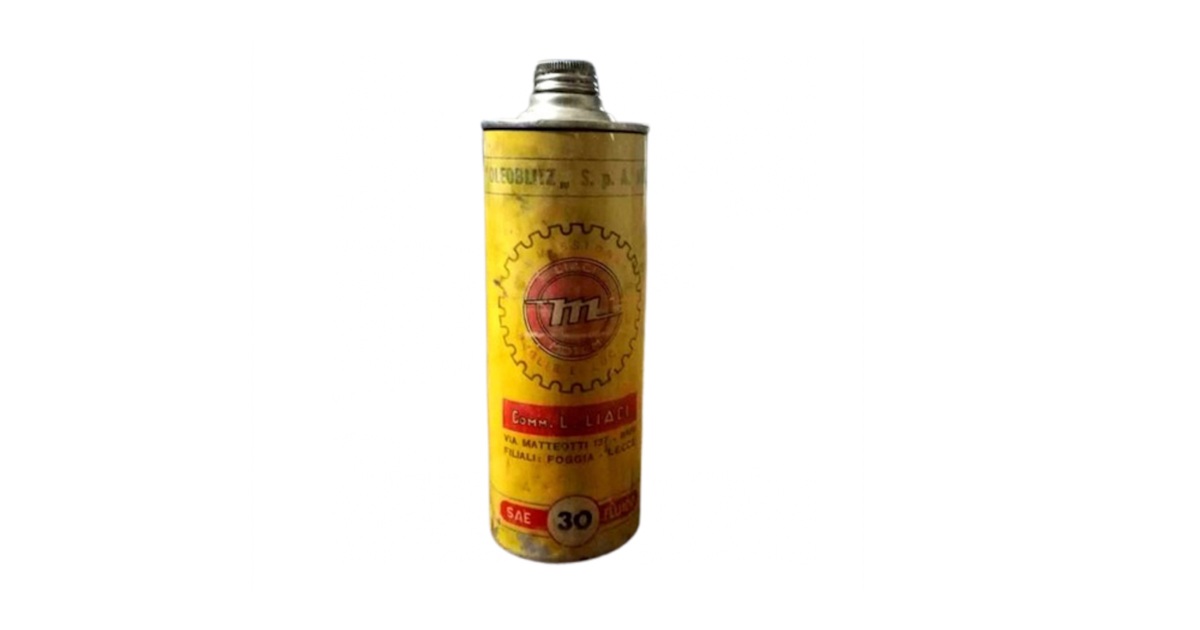
If you own a Motom and are looking for the right oil, get ready for a few surprises. It’s not as simple as checking the manual and buying what it recommends—the world has changed since 1947, and so has motor oil. Let’s start from the beginning.
Synthetic or mineral?
First key question: synthetic or mineral?
Synthetic oils offer numerous advantages: greater thermal stability, better wear resistance, lower friction, fewer deposits, less frequent oil changes, and better cold-start performance.
There is only one problem, but it is a significant one: synthetic oil is detergent-based. If the connecting rod’s centrifugal filter* is clogged with sludge—and it often is in motorcycles that have been idle for years—the synthetic oil dissolves it and carries it into the bearings. Result: risk of connecting rod failure.
Synthetic oils are also more "stable": their viscosity varies less with temperature changes than that of mineral oil. This is an important advantage, but one that must be put into context.
Golden rule: If you’ve just bought a Motom and don’t know what’s inside the engine, use mineral oil. If, on the other hand, you’ve opened up the engine, cleaned everything out, and know what you’re dealing with, synthetic oil is the best choice.
Single-grade or multi-grade?
The Motom manual specifies SAE 30, or SAE 40 if it's very hot. Single-grade, period.
Why single-grade? Simple: back then, multigrade oils didn't exist. It's not a sophisticated technical choice—it's just a historical limitation.
These days, it’s wiser to use a multigrade oil, especially if you ride your motorcycle in both summer and winter. A multigrade oil adapts better to temperature fluctuations and ensures smoother cold starts.
Which multigrade oil to use — watch out for washout
Note: Hot-weather multigrade oils are generally thinner than single-grade oils of the same viscosity grade. A 10W-30 oil is thinner at high temperatures than a SAE 30 single-grade oil.
This means that in the summer, when temperatures are high—on a steep incline or in slow-moving traffic—oil that is too thin can “wash away” from the surfaces. The lubricating film thins out, increasing the risk of seizure. It’s no coincidence that Motom recommended 40 instead of 30 in high temperatures.
That’s why a balanced choice for year-round use is a 15W-40 or 10W-40—fluid enough in cold weather and viscous enough in hot weather. Always check the technical specifications: the range of variation can be quite wide.
An air-cooled engine is particularly sensitive to temperature fluctuations compared to a liquid-cooled engine. The oil film is at greater risk of being washed away, so choosing the right oil is even more important.
What kind of oil should I use?
Personally, I use 5W-30—but my Motom has specific characteristics that make this choice the right one for me.
Using an oil temperature sensor, I measured that in the summer, 5W-30 maintains a temperature about 5°C lower than 10W-30. Given how I use the Motom—long trips—it’s important to have good oil flow, and the piston pump pumps low-viscosity oil more easily.
That said, my engine has a forced-air cooling system that provides better thermal balance than a standard model. For a standard Motom, especially when used in the summer or in the mountains, 15W-40 or 10W-40 is probably the safest choice.
Every Motom is different
Lubrication systems vary from model to model, so the requirements also vary:
- Models with a small piston pump
- Models with a large piston pump
- The drive cam can be single or double (double-acting)
- For the lucky ones: gear pump
Every engine is different, and you should choose your oil accordingly. Variety is the spice of life!
The final question
Some people will tell you to use SAE 30, as specified in the Motom manual. That’s a valid choice. But it’s worth asking yourself:
Today, in 2024, which oil would Motom choose for its small 4-stroke engine?
The answer, most likely, wouldn't be SAE 30. That's what Motom is all about: the freedom to make your own choices.
Oh, I almost forgot: Motom recommended Mobil oil!
*Before choosing an oil, be sure to read our guide on how to rebuild the Motom crankshaft—you’ll see why choosing the right oil is even more important than you think.
If you found this article useful and would like to help keep Motom Club alive, you can support the project with a small contribution.
SUPPORT MOTOM CLUBAll content on this site is protected by copyright. Reproduction, even partial, is prohibited without written permission.