
The story of a project created to collect, share, and preserve the history of Motom before it is lost.
Why did I create DAS MOTOM instead of writing a book about Motom?
It's a question that often comes up when new enthusiasts discover the project.
To be honest, it always makes me feel a little awkward.
I've only been working with Motom for a few years…
But that's exactly where the problem lies.
In the world of collecting, you never stop learning. Every year, a previously unknown catalog, an unpublished photograph, a firsthand account, or a technical detail turns up that changes what we thought we knew.
Every new discovery forces you to go back and revise what you've already written.
And so the perfect book always remains a work in progress. Always a chapter to revise. Always a page to rewrite.
I didn't want to wait ten years.
Because, in the meantime, the story goes on.
There was also a specific moment when I realized I couldn't wait any longer.
The passing of a historic figure in the Motom community made me reflect on something I had underestimated until then: time.
Every year, we lose people who experienced the Motom when it was still an everyday mode of transportation. With them go memories, anecdotes, photographs, documents, and knowledge that, all too often, have never been shared.
I wondered how many stories had already been lost.
And how many more would we have missed while waiting for the right moment?
That's when I decided to get started.
Not because I thought I knew everything, but because I realized that every month of waiting could mean one less testimony.
In a way, DAS MOTOM wants to stop time.
Like a photograph.
Not out of nostalgia, but to preserve what might no longer be there tomorrow.
That's why DAS MOTOM was founded.
A magazine does not claim to be definitive.
It can grow alongside the community. It can keep up with the times, delve deeper into a topic that has already been covered, and make room for new discoveries. Each issue is a snapshot of the moment, but also an invitation to continue the exploration.
There is also another reason, perhaps even more important.
A book almost always has a specific theme. It might tell the story of all the models, explain how to restore a Motom, recount a journey, or explore a technical topic in depth.
My passion, on the other hand, doesn't follow a pattern.
One day I find myself studying a carburetor; the next day, reading a document from 1946. Then I set off on a trip, meet a collector, discover a long-forgotten photograph, try out a new replacement part, or interview an enthusiast.
That's exactly how I experience Motom.
And I think that's how many fans experience it.
The magazine allows me to share all of this without having to choose just one direction. I can move from history to technology, from a journey to a restoration, from an interview to a historical tidbit, maintaining a common thread while giving my passion the freedom to express itself.
Perhaps that is precisely the difference.
A book takes the reader along a single path.
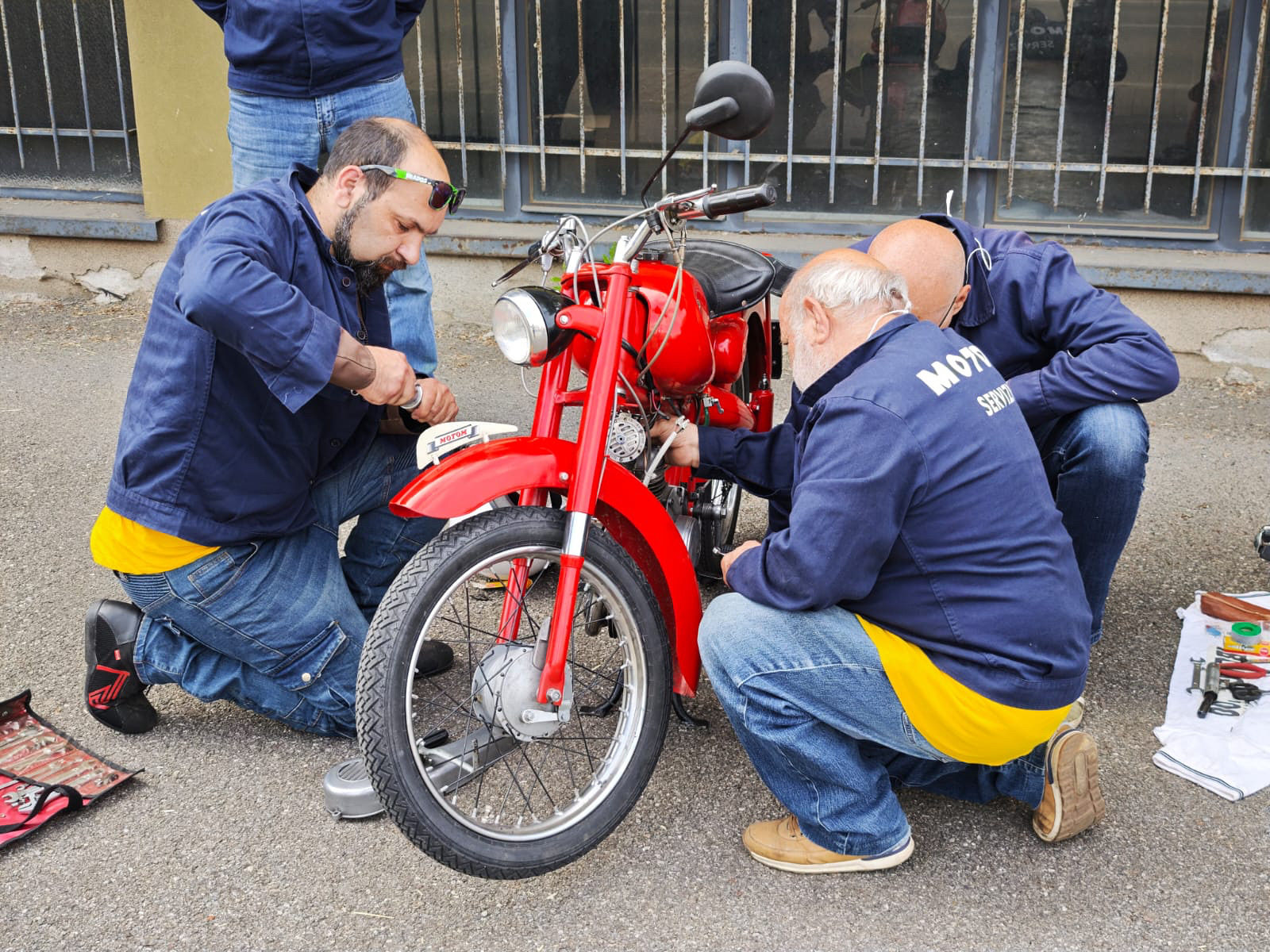
DAS MOTOM, on the other hand, is like a day spent in the garage with friends: you start out talking about an engine, end up flipping through photos from sixty years ago, discuss a technical detail, and—before you know it—you’re already starting to plan your next trip.
I often wonder if I'll ever be the person who knows Motom best.
The answer is no.
There are enthusiasts who have been studying these motorcycles for forty years, who possess incredible archives, rare documents, and a level of expertise that I can only admire.
But then I ask myself another question.
What good is all that knowledge if it stays locked away in a drawer?
Maybe this is a bit provocative, but I believe that knowledge has value only when it is shared.
You may know everything there is to know about Motom, but if no one can ever learn it from you, part of that legacy is bound to disappear.
On the contrary, you may know less, but if you’re eager to share, write, exchange ideas, and make your discoveries available to everyone, then you’re helping an entire community grow.
This is the philosophy behind DAS MOTOM.
I don't want to be the one who knows more than everyone else.
I'd like to be the one who shares the most.
Of course, a magazine alone isn't enough.
That's why the Motom Club website was created.
The website is where news breaks first, where articles can be updated, and where events, trips, restorations, and new discoveries are shared.
The magazine has a different purpose.
It doesn't chase after current events, but selects what's worth preserving. It gathers the most significant articles, explores them in depth, and transforms them into something that can still be leafed through even twenty years from now.
After all, the two projects complement each other.
The website tells the story of the present.
The magazine preserves our memory.
What about social media?
I'm simply the way to bring new fans together and guide them here.
I didn't want to write the definitive book on Motom.
I wanted to create a place where the history of Motom could continue to be written. On paper. Because paper has a memory that digital media will never have. And no server shutdown will ever be able to erase it.
Because the value of what we know isn't measured by how rare it is, but by how many people it will help after we're gone.
If you share this view,
Welcome to DAS MOTOM

To reserve your copy: DAS MOTOM – The first magazine dedicated to the history of Motom
If you found this article useful and would like to help keep Motom Club alive, you can support the project with a small contribution.
SUPPORT MOTOM CLUBAll content on this site is protected by copyright. Reproduction, even partial, is prohibited without written permission.