
The Motom's decline unfolded slowly, over the course of an entire decade. It didn't collapse overnight—it faded away year by year, model by model, as the market moved in a different direction.
There is a specific moment when Motom’s story ceases to be a success story and becomes a story of catching up. It isn’t 1970, when the factory closed. Nor is it 1963, when the company began selling a French moped with its own brand name slapped on it just to have a two-stroke model in its catalog. The moment is 1959—when the new Highway Code rewrites the rules of the market and Motom finds itself with the wrong product for a market that is about to explode.
1959: The Code That Changed Everything
In 1959, the new Highway Code came into effect, to be enforced starting in early 1960. The rule was simple: all mopeds must have a maximum engine displacement of 49.9 cc, power limited to 1.5 hp, and a top speed of 40 km/h. No license required, no insurance required, and rideable from age 14.
The market responded immediately. By 1961, nearly 100,000 mopeds were already being sold in Italy. By 1967, that number had risen to 200,000. By 1971, the figure would reach 400,000. It was an unprecedented boom, driven by a new demand—that of young people. Fourteen-year-olds who wanted freedom, speed, and a vehicle of their own. Not their fathers’. Not their grandparents’.
The Motom 48, introduced in 1947 to provide transportation for a poor, war-torn Italy, is exactly the kind of scooter our fathers and grandfathers rode. Those who lived through that era remember it this way: sturdy, reliable, economical—but old. A workhorse in a market that was getting younger.
1960–1965: The market splits in two, and Motom is left out
In those years, the moped market was clearly divided. On one side were manufacturers with their own engines, their own identity, and above all a history rooted in two-stroke engines—Garelli, Rizzato, Guzzi, Benelli, and of course Piaggio with the Vespa 50. On the other, a galaxy of frame builders who bought their engines in Bologna—from Morini Franco Motori or FB Minarelli, both spun off from the same FBM founded in 1951 by Franco Morini and Vittorio Minarelli—and built their own chassis around them. Cimatti, Peripoli, Malaguti, Italjet, Fantic Motor: different brands, same engine, each with its own personality.
The barrier to entry in the market has fallen. Anyone with a frame and a good deal with Bologna can sell mopeds. The market is flooded with new, colorful models designed for young people.
Motom isn't part of either group. It doesn't have its own two-stroke engine, it doesn't buy engines from Bologna, and time just keeps passing…
It features only the 48cc four-stroke engine, which it will adapt to meet road regulations and name the Motom Codice: the same engine and frame as in previous years, with the addition of a (patented) restrictor on the carburetor.
Grandma and Grandpa's scooter
Those who lived through those years describe it clearly. The Motom was already seen as outdated even before the Nova models came out. It was the moped of their fathers—of those who had bought their first one in 1952 and never replaced it. The young people of the 1960s were looking elsewhere.
And “something else” meant speed: the records set a few years earlier at Monza with the 4-stroke were no longer enough to make the Motom appealing… In those years, the two-stroke was undergoing a silent but radical technical revolution—expansion mufflers, aluminum cylinders with chrome-plated liners, carburetors of increasing diameter—that transformed it from a utilitarian vehicle into a tunable object of desire. The Minarelli P4, the Garelli Junior, the Itom Asturo: mopeds that kids modified in their garages, that went fast, that could be made even faster. The Motom four-stroke couldn’t keep up—technically, aesthetically, or culturally—and the modifications needed to make it go fast couldn’t be done in a garage; you had to be a professional mechanic with specialized equipment, and to gain a few kilometers per hour, you had to spend a lot of money: valves, cylinder heads, cylinders, pistons, carburetors… madness compared to enlarging two ports with a file and little else.
We will soon publish a dedicated article on the technical revolution of two-stroke engines in the 1960s—what really changed and why four-stroke engines couldn’t compete.
1965–1969: Nova and Daina—too little, too late
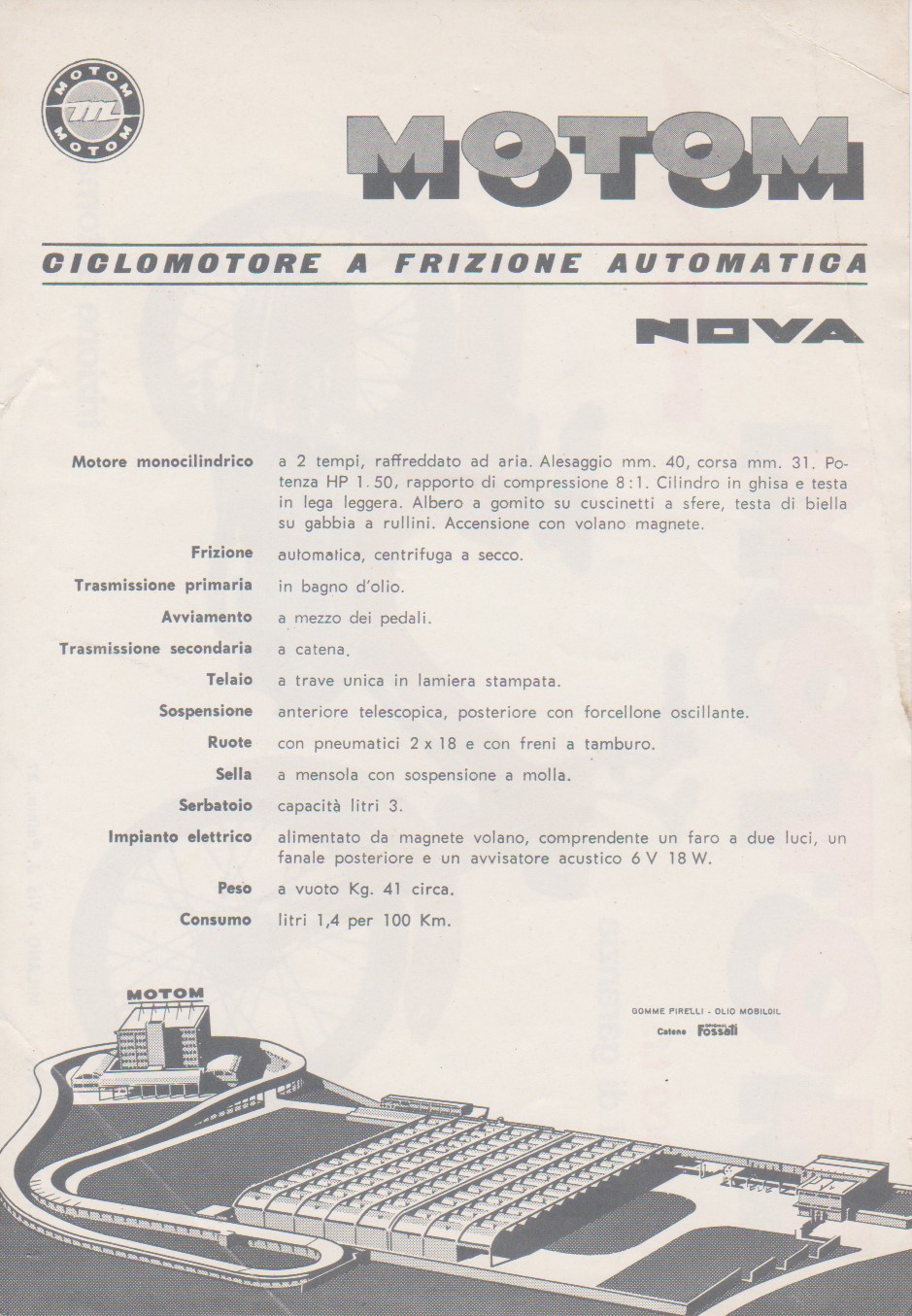
Motom's response came very slowly, first with the BB1 imported from Peugeot in 1963 and then in 1965 with the Nova series—produced by Nova Motori SpA, which was founded in 1962 in Riva del Garda. But it was a response that failed to convince anyone.
The first model, the Nova 40, has just 38cc—less than the 48cc of the old four-stroke. It’s slow, gets good gas mileage, and has a fuel tank under the seat in an unattractive position. It can’t be tuned. It has nothing to set it apart from the competition; in fact, it often falls short. The automatic clutch slips, the engine overheats, and the spark plugs get dirty. Older riders who try it compare it to the 48 and miss the four-stroke. Young people don’t even give it a second glance.
Starting in 1967, the Daina series addressed its most serious technical flaws—an improved clutch and a slightly revised engine—and production numbers rose: 21,000 units in 1967, 30,000 in 1968, 35,000 in 1969. But this growth was illusory. The overall market was growing much faster, and Motom’s market share was shrinking every year. And the fixed costs of the two plants—Bollate and Riva del Garda—weighed on every unit sold.
Nova and Daina are not original products. They are average—or below-average—mopeds in a market where average is no longer enough.
A failure on the engine front as well
There is one aspect of the Motom crisis that is almost always overlooked: it is not just a matter of identity or commercial setbacks. It is a defeat on the industrial front that matters most—that of the engines.
The decision to build its own engines had been the strength of the 48. But replicating that feat with two-stroke engines, on a tight schedule and without Piaggio’s resources or Garelli’s industrial heritage, proved impossible. When the Nova models ran into problems, there was no external supplier to turn to. Piaggio built its own engines and won. Garelli built its own engines and held its own. All the others survived by buying from Minarelli or Franco Morini.
Motom didn't realize this until 1969, with the 121 Cross—its final model—when it decided to switch to the four-speed Minarelli P4 S. It was the right choice, but it came ten years too late.
The End. The Decline of Motom
In 1969, Motom’s production reached its peak. By the end of the year, the decline had already begun. The final models—Dainella, Dainella Emme, Daina Lusso—were built with imported Peugeot engines, in a desperate attempt to cut costs by abandoning in-house production. It was a surrender.
In May 1971, Nova Motori’s share capital plummeted from 300 million to 900,000 lire. On September 18, 1978, the company filed for bankruptcy.
Motom closed its doors in 1971. The moped market it had helped create would reach its all-time peak in 1980—a market it did not live to see.
Just consider what Piaggio did with the Ciao in 1967. It didn’t introduce anything revolutionary from a mechanical standpoint—the engine was simple, the suspension was practically nonexistent, and the frame was basic. But it built a generational identity from scratch: an instantly recognizable name, an advertising campaign that spoke to young people, and a price of 54,000 lire that put it within everyone’s reach (in the same year, Motom had the Daina at 68,000 lire). The Ciao wasn’t the best scooter on the market. It was the right scooter for that moment. Over forty years, 3.5 million would be sold. In 1968, Piaggio sold 130,000 Ciao scooters, while only 30,000 Daina models were produced. Motom, during the same period when Piaggio was building that identity, was still trying to get a clutch to work, and the Nova plant had already been in operation for three years.
The next article will provide a detailed overview of all Motom 2-stroke models—including technical specifications, production figures, and versions that never made it into production.
To read the history of Motom: Motom History: From the Beginnings to 1970
- Sources for the Motom figures: *Motociclismo d'epoca* 8-9/2008, which in turn cites Piero Bersan of the Motom Museum as its source (we’ll cover this in a future article)
- Sources on the moped market in Italy: Confindustria Ancma
If you found this article useful and would like to help keep Motom Club alive, you can support the project with a small contribution.
SUPPORT MOTOM CLUBAll content on this site is protected by copyright. Reproduction, even partial, is prohibited without written permission.