
The history of Motom officially began in 1947. Or so the story goes.
Milan, 1947: The De Angeli Frua family, textile entrepreneurs with a keen eye for opportunity, decided to venture into the motor vehicle industry. Their reasoning was simple: Italy would need affordable, reliable motorcycles that everyone could afford. All that was missing was the right design.
It is Battista Falchetto who brings it to him.
The date and city listed in every magazine and website dedicated to Motom—Milan, 1947—are universally accepted as fact. But the reality of its origins is more complex and surprising than has ever been written. Who really founded Motom, where, and when? We’re working on a dedicated article to tell the story properly.
The man behind the Motom story
Falchetto is no ordinary designer. He was the right-hand man of Vincenzo Lancia, the engineer who revolutionized automotive suspension with independent front wheels. He brings with him a mindset rooted in high-level motorsports: stamped sheet metal structures, clean industrial solutions, and zero compromises on strength.
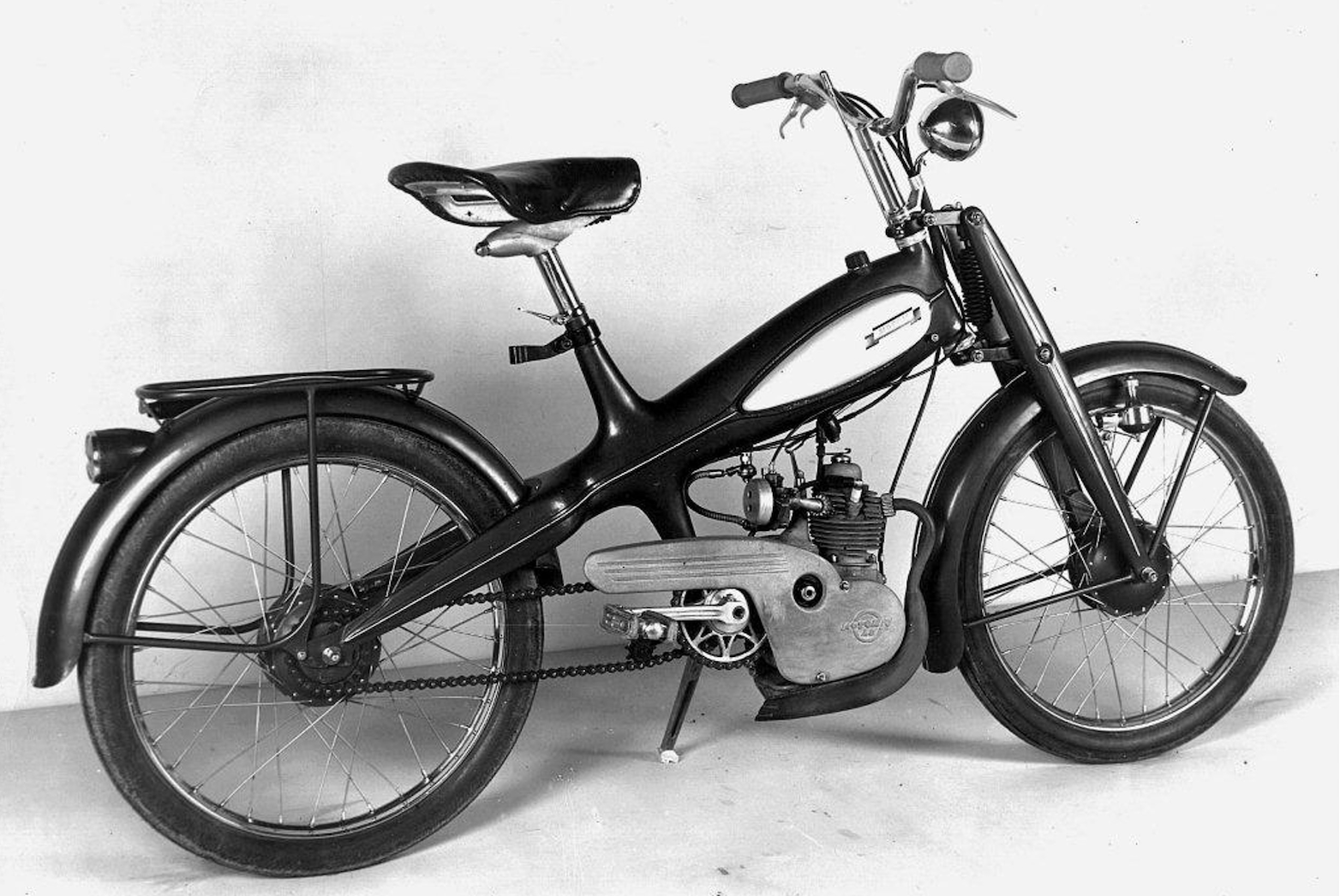
The idea Frua presented to the De Angeli brothers was ambitious in its simplicity: a 48-cc, four-stroke moped with an X-shaped pressed-steel frame—two half-shells welded together, with no tubes. A structure that was unprecedented in the world of mopeds, but one that Falchetto knows well because it belongs to the world of automotive bodywork.
To build the prototypes, an industrial supply chain was established: the Farina body shop for the bodywork, the Ghirò workshops in Turin, and the Frua plant in Milan for the mechanical components.
1947: The Motomic, the first Motòm*, is born
The first model is called Motomic—a portmanteau of "Moto Atomica," a name intended to sound modern, almost futuristic, at a time when the word "atomic" evoked progress and the future. It was unveiled at the 1947 Geneva Motor Show.
It weighs 37 kg. It has a 48-cc single-cylinder four-stroke engine that delivers 1.4 hp at 4,500 rpm and can take the rider over 50 km/h on one liter of gasoline per 75 km. Figures that seem modest today but which, at the time, represented an extraordinary balance between performance and fuel economy.
The X-shaped frame is the real innovation* that everyone is talking about. The two pressed-steel half-shells form an extremely rigid yet lightweight structure—something impossible to achieve with traditional welded tubes. The "soapbar" fuel tank is recessed between the two frame elements, just behind the steering head. The front fork is rigid, as is the rear end—essential, spartan, and sturdy.
All the controls are on the handlebars: the left hand operates the gearshift, clutch, and front brake; the right hand controls the throttle and rear brake. It’s a system that motorcyclists still use today.
The Motomic quickly became the Motom 48, a model that would remain in production for over twenty years and see production exceed half a million units.
*Motòm — with the accent on the final "o." It's a detail that few people know about, and one that hides an interesting story. We'll come back to this as well.
*For decades, trade magazines have been repeating the same story: the Motom’s X-frame, a groundbreaking innovation and a revolution in the world of mopeds. Too bad that’s not exactly how it went down. Falchetto’s true invention is more complex—and more interesting—than what has always been written. We’re preparing a dedicated article to tell the story properly, so as to clarify and add a new piece to the history of Motom
The 1950s: The Motom Story Evolves
The 48 doesn't stand still. The 1950s saw the first significant changes to the chassis: in 1954 the frame was updated, in 1955 the rear swingarm suspension was introduced, and in 1957 the telescopic front fork arrived, definitively replacing the rigid fork of the early models.
Also in 1957, the 51 cc version was introduced—technically a variant with a slightly larger bore—which, by law, allowed the motorcycle to carry a passenger, provided it was registered and had a license plate.
Meanwhile, Motom was trying to expand its lineup. In 1950, at the Milan Motor Show, it unveiled the Delfino: a full-fledged motorcycle with a 147 cc engine, a single-beam frame, and a design that blended traditional motorcycle features with elements derived from scooters. It went into production in 1952 with the displacement increased to 163 cc and 7.5 hp. It was not a commercial success—the production lines were already running at full capacity with the 48—and it was discontinued in 1959.
In 1955, it was the turn of the 98 T, unveiled at the Milan Motor Show: a motorcycle with a nearly fully faired body, decades before full fairings became the norm. A bold design—perhaps too bold. Technical issues and a market that wasn’t yet ready for it led to poor sales.
The 1960s: The Golden Age of Sports
The 48 continues to evolve. In the 1960s, sport versions were introduced, pushing the top speed past 75 km/h while maintaining exceptionally low fuel consumption. Among the most memorable models is the 48 SS, with a 48 cc engine, 2.6 hp, and the performance of a true sports bike.
The Motom also made history at Monza in 1958, where class records were set with the 48. The Motom on the track is a parallel story, one of tuners and riders who pushed the engine far beyond its stock limits. A 48cc moped capable of speeds over 110 km/h: proof of just how oversized Falchetto’s original design was and how ready it was for tuning.
During those same years, Motom introduced models for alternative uses: a three-wheeled commercial utility vehicle powered by the 48cc engine, and a rotary tiller equipped with the same engine adapted for agricultural use. This demonstrated that the engine was more than just a powerplant for mopeds.
Sunset
Motom didn't just produce the 48. Over the years, it experimented with 60- and 100-cc models, the 100 Junior, and other variants. But none of them achieved the success of the original model.
In the mid-1960s, the market changed. Economic prosperity led Italians to turn to cars. Competition became fiercer. Even the attempt to manufacture Peugeot mopeds under license—which were extremely popular in France—failed to win back a customer base that was gradually turning away from mopeds.
Motom ceased operations in 1970.
The Motom story didn't end in 1970
This is the story of Motom: a motorcycle meant to be ridden, not a museum piece.
Half a million units produced over more than twenty years, an engine that required very little maintenance throughout its production run, and a chassis that collectors still find in pristine condition seventy years later.
What remains is Falchetto's project: an engineer with a background in the automotive industry who applied an extraordinary industrial approach to the moped.
And there remains a community of enthusiasts who, even today, seek out, restore, and ride these bikes. The Motom isn’t a museum piece—it’s a motorcycle meant to be ridden.
For more on the decline of Motom: Motom: When a Brand Fails to Reinvent Itself
If you're trying to get your Motom running again, start with "Do you have a Motom? Where to start"
If, on the other hand, you want to know the value of your Motom: How much is your Motom worth today! 2026
The original patent for the frame can be viewed at [GooglePatents] https://patentimages.storage.googleapis.com/fd/ea/66/9f7c694d3ac982/US2545142.pdf
If you found this article useful and would like to help keep Motom Club alive, you can support the project with a small contribution.
SUPPORT MOTOM CLUBAll content on this site is protected by copyright. Reproduction, even partial, is prohibited without written permission.